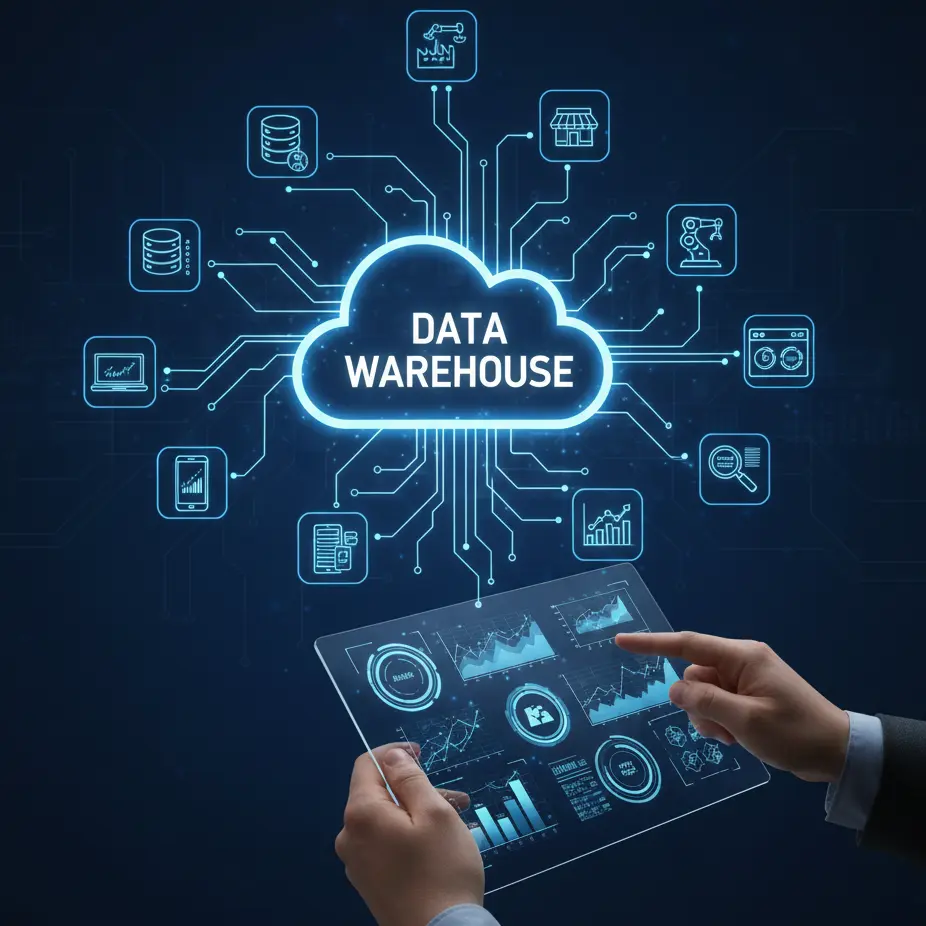
In most SMEs we meet, the data is spread across an accounting package, an ERP or CRM, a couple of online tools and a lot of spreadsheets. None of them talk to each other. Reports get rebuilt by hand every month, the numbers rarely match, and the answer you get depends on whose file you open. A data warehouse is how you fix that.
Ten years ago this was something only large companies could afford. Cloud platforms have changed that. You can now start with a small warehouse, pay for what you use, and grow it as the business grows. If you're still deciding whether your reporting has outgrown spreadsheets at all, start with our Power BI vs Excel guide.
Key takeaways
- A data warehouse puts the data from all your systems in one place, cleaned and consistent.
- It's worth it once your numbers live in too many places to agree with each other.
- You don't have to build it all at once. Start with one area, like sales, and grow from there.
What Is a Data Warehouse, Really?
A data warehouse is a central database built for reporting. Data from your different systems is copied into it on a schedule, cleaned up and organised, so reports can be built from one place instead of five.
One way to picture it: your systems are shops on different streets, each with its own stockroom. The warehouse is the central depot. Everything arrives there, gets checked and labelled the same way, and then goes out to whoever needs it, whether that's finance, sales or the managing director.
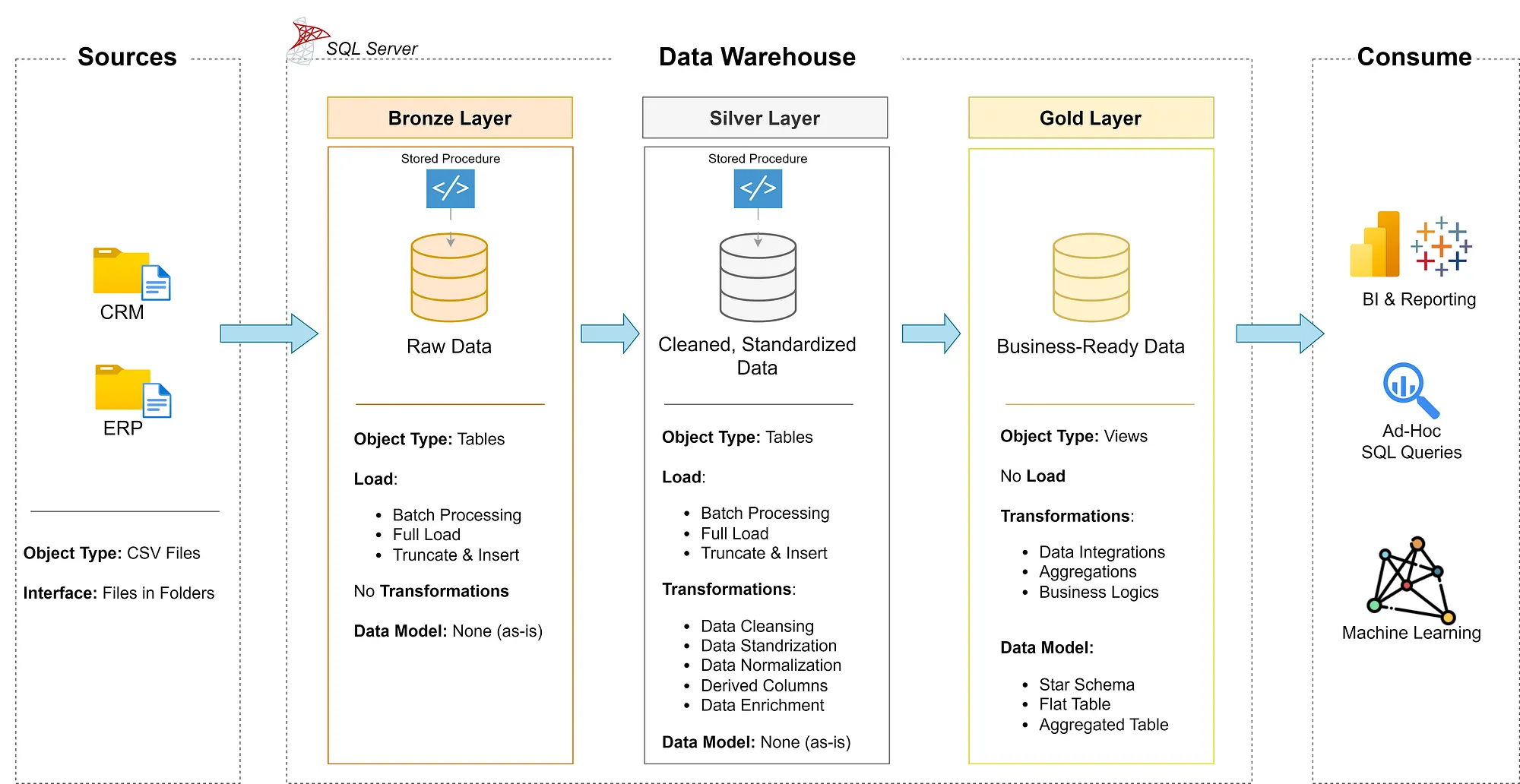
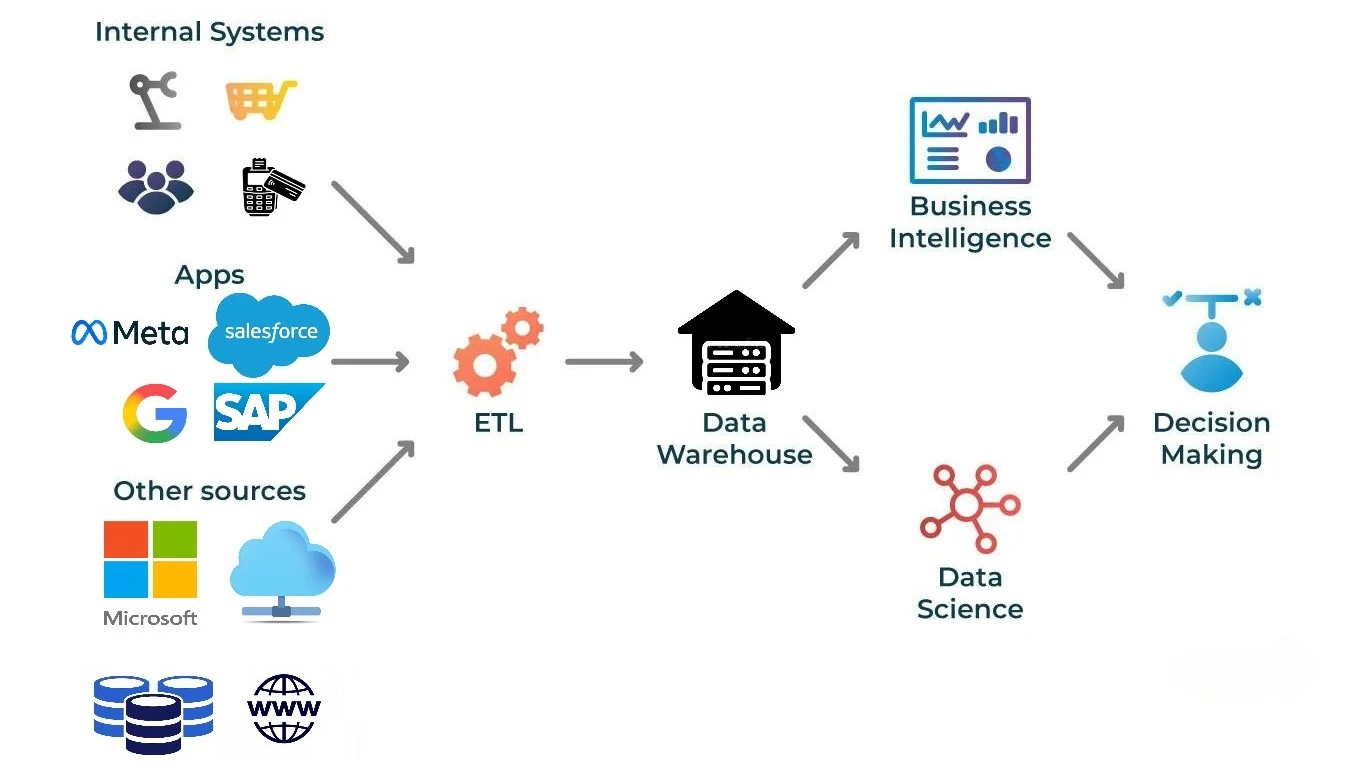
Behind the scenes, it works in four steps:
- Data Ingestion: Bringing data from various sources (ERP, CRM, marketing tools, POS systems, spreadsheets, web apps) into a single pipeline.
- Data Transformation: Cleaning, standardizing, and joining data so that “customer” or “product” means the same thing across systems.
- Central Storage: Storing this prepared data in a performant, query-optimized environment – typically a cloud data warehouse.
- Analytics & Reporting: Connecting BI tools and dashboards so teams can explore metrics, trends, and insights in real time.
Why Data Warehousing Matters for SMEs
Here's what changes in practice once the warehouse is in place:
1. One Source of Truth for the Whole Business
When sales and finance bring different revenue figures to the same meeting, half the meeting goes on working out whose is right. With a warehouse, revenue, margin and stock are calculated once, the same way, and everyone sees the same number.
2. Better Decisions, Faster
Instead of waiting until the 10th of the month for last month's report, you can look at the numbers any morning. Filter by country, branch, product or customer and spot a problem while you can still do something about it.
3. Data That’s Ready for AI and Automation
Everyone wants to "do something with AI", and most projects stall at the same point: the data is scattered and messy. Forecasting, churn prediction or an AI assistant that answers questions about your business all need clean, structured data first. The warehouse is that foundation.
4. Lower Operational Risk
If your key report depends on one spreadsheet that one person understands, you have a risk, even if it has never gone wrong. A warehouse keeps the logic in one documented place, so holidays, sick days or someone leaving don't stop the reporting.
5. Scaling Without Losing Control
A new branch, a new e-shop, a new country. Every step adds another system and another export to copy and paste. With a warehouse, a new source is connected once and flows into the reports you already have.
6. Cost-Efficient Analytics with Cloud Technologies
Cloud platforms mean you no longer buy servers or pay big upfront licences. You pay for what you use, which for a typical SME is a modest monthly cost. The bigger investment is the setup work, and that is a one-off.
How Different Teams Use a Data Warehouse
It isn't only for management reports. Once the data is in one place, every team can use it:
Sales & Marketing
Track funnel performance, campaign ROI, and customer lifetime value across channels.
Finance
Consolidate revenue, costs, and cash-flow data from multiple systems into consistent reports.
Operations & Supply Chain
Monitor stock levels, supplier performance, delivery times, and forecast demand more accurately.
Management & Strategy
View unified KPIs, compare scenarios, and align teams around the same set of performance metrics.

Getting Started with Data Warehousing as an SME
Your first warehouse doesn't need to be a big project. This is the order we usually follow with clients:
- Clarify Your Business Questions: Write down the 5 to 10 questions you need answered every month, like revenue, margin, stock or overdue invoices.
- Map Your Data Sources: List the tools and systems where relevant data currently lives and who owns them.
- Choose a Modern Data Platform: For most SMEs a cloud platform is the sensible choice. If you already use Microsoft 365, Microsoft Fabric or Azure fit naturally.
- Start with a Focused Use Case: Sales and revenue is usually the best first area. Get it right, let people trust it, then add the next one.
- Invest in Data Governance: Decide who owns each data source and who can see what. It sounds boring, but it's what keeps the numbers trustworthy a year later.
The Bottom Line
You don't need a data warehouse because it's fashionable. You need one when your numbers live in too many places to agree with each other, when reports take days to assemble, or when you want to use AI and realise your data isn't ready for it. If that sounds familiar, start with one business area, prove it works, and build from there.
Want help implementing a data warehouse or BI dashboards? We work with SMEs across Cyprus and Greece. Visit our Services or Contact us.
About the author
Data Superheroes helps SMEs build analytics systems: data pipelines, warehouses, dashboards, and AI automation.